
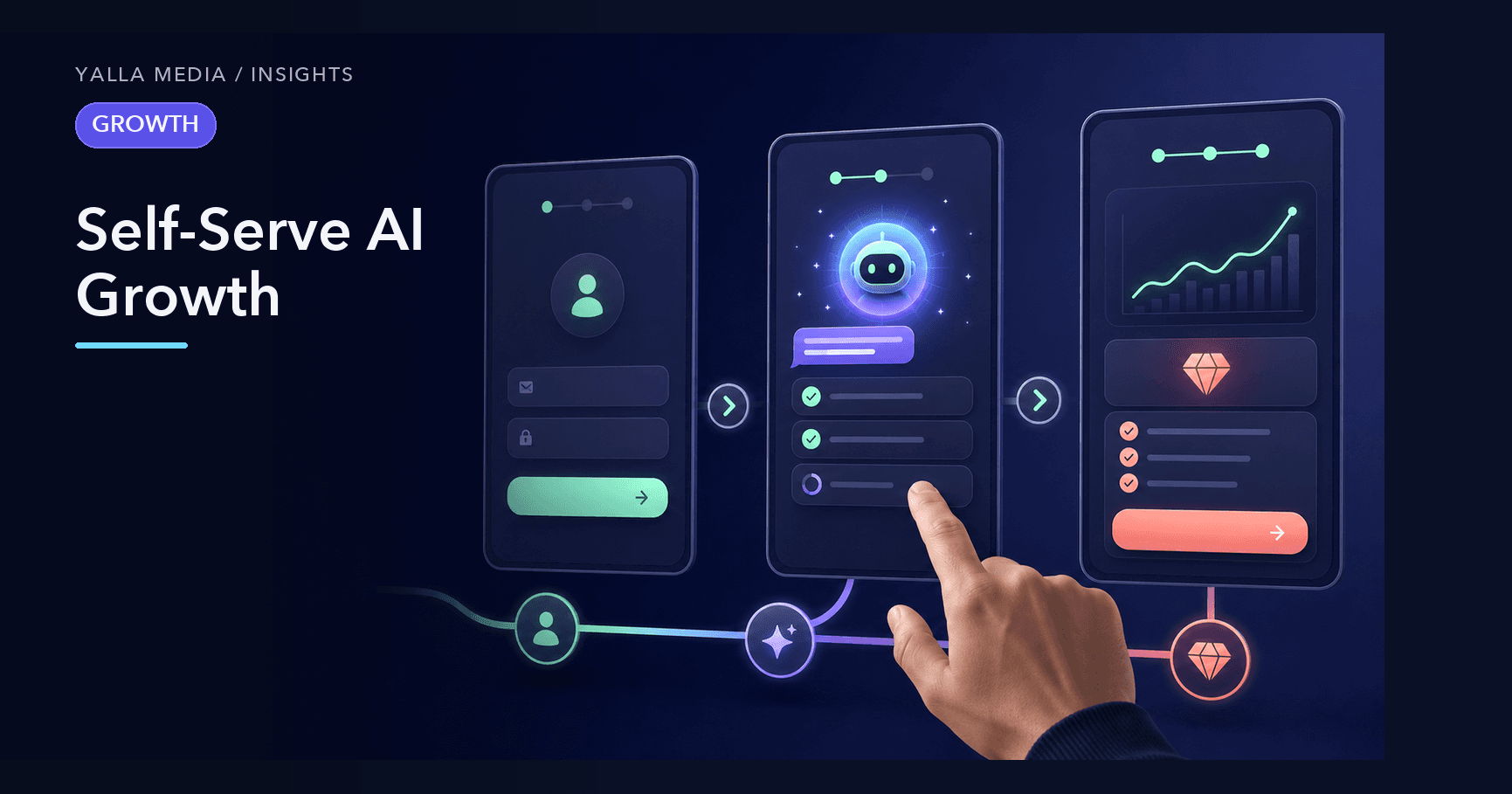
Self-serve growth has a brutal honesty to it. There is no salesperson to bridge the gap between a confused first impression and the product's real value — the product has to do that itself, in one session, often in a few minutes. For AI products this is sharper still, because the value can feel magical when it lands and baffling when it does not. The whole game is getting a new user from arrival to genuine value fast enough that they want to keep going, and then earning the upgrade honestly rather than buying it with discounts. This playbook covers the three moves that decide it: onboarding, the aha moment, and conversion.
The reason to get this right is leverage. Self-serve growth compounds in a way sales-led growth cannot, because every improvement to the first session pays off across every user who ever signs up. A few points of activation, gained once, keep paying forever. But the same logic runs in reverse: a confusing onboarding quietly taxes every future cohort. The first session is the highest-leverage surface in the entire business.
Onboarding: get to value, not through a tour
Most onboarding is built backwards. It explains the product — a tour of features, a checklist of setup steps, a tooltip on every button — when what the user actually wants is to experience the product doing something useful for them. A feature tour teaches the interface; it does not deliver value. The goal of onboarding is not comprehension. It is the user reaching a real result as quickly as possible.
Design the shortest path to a real result
Identify the single most valuable thing a new user can experience, and engineer the most direct route to it. Strip everything that stands between arrival and that first result. Every required step, every form field, every decision you ask for before delivering value is a place users leak away. The discipline is ruthless subtraction: not what could we show them, but what is the least we can ask before they feel the product work.
- Defer setup that is not required for the first win. Configuration can wait until the user has a reason to care. Front-loading it spends goodwill before any has been earned.
- Use a sensible default for everything you can. Every choice you make for the user is one they do not have to make to reach value.
- Show, do not tell. Let the user do the valuable thing with their own input, rather than watching a description of it. Doing creates belief; reading does not.
- Remove dead ends. At every step the next valuable action should be obvious. Ambiguity in onboarding is abandonment in disguise.
Onboarding is not where you teach the product. It is where the product proves itself. The best onboarding feels less like a tutorial and more like the product simply working on the first try.
The aha moment: define it precisely
The aha moment is the instant a user genuinely understands the value — the moment the product stops being a thing they are evaluating and becomes a thing they want. Many teams talk about it vaguely. The teams that grow define it precisely, because a precise definition is something you can measure, instrument, and optimize toward.
Make it a specific, observable action
A real aha-moment definition is a concrete action a user takes that strongly predicts they will stick. Not a feeling — an event you can see. For an AI product it is usually the moment the user receives output good enough that they think yes, this is for me. Your job is to identify the specific action that captures that moment and then orient the entire first session around getting users to it.
Find it empirically, not by guessing. Look at the difference between users who stay and users who leave, and identify the early action that separates them. That action — performed early, by enough users — is your aha moment made measurable. Once you know it, activation has a clear target: the share of new users who reach that action in their first session.
If you cannot name the single action that turns a tryer into a believer, you cannot reliably grow. Define the aha moment as an event you can count, and the rest of the playbook gets a target to aim at.
Engineer toward the moment relentlessly
With the aha moment defined, every onboarding decision gets a sharp criterion: does this help more users reach the moment, sooner? Steps that move users toward it stay. Steps that delay it go, no matter how reasonable they once seemed. This single question resolves most onboarding debates, because it replaces opinion with a shared objective.
Conversion: earn the upgrade without discounts
The temptation, when conversion lags, is to reach for a discount. It feels like it works because it moves a short-term number, but it is a tax on every future customer and a signal that the product is worth less than its price. Durable self-serve conversion is earned a different way: by making the paid value obvious and the upgrade a natural next step for someone who is already getting value.
Convert on value realized, not pressure applied
The users who upgrade willingly are the ones who have already felt the product work and have bumped into the edge of what the free experience offers. So the path to conversion runs straight through activation: get more users to value, let them use the product enough to want more of it, and present the upgrade exactly when the desire for more is real.
- Make the free experience genuinely useful. A free tier that is too thin never lets users fall in love; one that is too generous removes the reason to pay. Tune it so users get real value and naturally reach for more.
- Surface the upgrade at the moment of need. The best time to offer more is when a user is actively wishing they had it — at the limit, not at random.
- Make the paid value concrete. Sell the specific additional outcome the upgrade unlocks, in the user's terms. Vague promises of more do not convert; a clear better result does.
- Remove friction from the upgrade itself. Once a user decides, the path to paying should be effortless. Every obstacle here loses people who were already convinced.
Why discounts are the wrong reflex
Discounting trains users to wait for the next discount, erodes the perceived value of the product, and attracts buyers motivated by price rather than fit — who tend to leave again quickly. None of that compounds; all of it has to be paid back later. A product that converts on realized value builds a base of customers who pay because the product is worth it, and those customers stay. That is the difference between buying growth and earning it.
The playbook as one loop
These three moves are a single loop, not a list. Onboarding exists to get users to the aha moment. The aha moment, defined precisely, gives onboarding its target and conversion its foundation. Conversion succeeds because users who reached value want more of it. Improve any one part and the others strengthen; neglect any one and the others cannot save it.
Run the loop with discipline — shortest path to value, a precisely defined and measured aha moment, and conversion earned through realized value rather than discounts — and self-serve growth becomes what it promises to be: a compounding engine where every improvement to the first session keeps paying off, for every user, indefinitely.