
Most paid media programs are stuck on a treadmill. Each month begins roughly where the last one ended: new creatives launched on instinct, budgets pushed and pulled by the latest dashboard reading, and very little carried forward except a vague sense of what felt like it worked. Spend goes up; understanding does not. The accounts that genuinely compound are built differently. They treat creative as a system that accumulates learning and attribution as a single, trusted source of truth — so that every cycle starts smarter, leaner, and more accountable than the one before it.
Compounding is the right word and the right goal. A creative system that learns means your cost to find a winning ad falls over time, because each test sharpens the next. Clean attribution means you stop wasting budget on channels that look good in a platform report but do nothing for the business. Put together, they turn paid media from a recurring gamble into an asset that grows in value.
Why most paid media never compounds
The failure is structural, not tactical. Two patterns repeat in nearly every account that plateaus. The first is creative amnesia: ads are produced, run, and retired without any durable record of what was learned, so the team relearns the same lessons quarter after quarter. The second is attribution fog: every platform claims credit for the same conversions, the numbers do not reconcile, and decisions get made on figures that flatter rather than inform.
Both patterns share a root cause. They treat each month as a fresh start instead of a deposit into a growing account of knowledge. Fixing them is less about working harder and more about building two systems that hold and use what you learn.
Build a creative system that learns
Creative is the largest lever in paid performance and, in most accounts, the most casually managed. The fix is to stop treating creative as a stream of one-off ideas and start treating it as a system with inputs, a process, and a memory.
Test to learn, not just to win
A creative test should produce two things: a result and an explanation. Finding a winner is useful for this month. Understanding why it won is what compounds, because it makes the next round of ideas better aimed before a single dollar is spent. To get the explanation, you have to test in a way that isolates the variable you care about.
- Change one meaningful thing at a time. Alter the hook, the visual, and the offer together and a result tells you nothing about which one moved the needle.
- Start from a hypothesis. Write down what you expect to happen and why, before the test runs. A test without a hypothesis is just paying to watch numbers wiggle.
- Give it enough signal. Calling a creative on a trickle of data is reading tea leaves. Let the test gather enough to mean something before you decide.
Keep a living library of learnings
The single most underused asset in paid media is a durable record of what works for your specific audience. Every test should add to it: the hypothesis, the result, and the takeaway, written so a teammate could act on it months later. Over time this library becomes a competitive advantage that no budget can buy — a map of what resonates that gets richer with every cycle. Without it, learning evaporates the moment the campaign ends.
A creative test that produces a winner but no recorded understanding has done half its job. The understanding is the asset, and it is the only part that compounds.
Industrialize the production of variations
A learning system is only as good as its ability to act on what it learns. Once you know which angles work, you need to produce fresh variations on those angles faster than they fatigue — because even winning creative wears out as audiences see it. The aim is a steady, efficient pipeline: take a proven angle, generate disciplined variations of it, feed them into the test process, and retire the tired ones. This is where modern tooling earns its place, helping a lean team produce volume without losing the thread of what is actually being tested.
Build attribution you can actually trust
You cannot compound what you cannot measure, and most measurement quietly lies. Browser-based tracking has grown unreliable as privacy protections and blockers strip away signal, which means conversions go uncounted — and uncounted conversions make good campaigns look bad. Meanwhile each platform happily claims credit for conversions it merely touched, so the numbers add up to more than the truth. The result is decisions made on a distorted picture.
Capture conversions at the source
The durable fix is to measure where you actually know what happened: your own systems. Server-side tracking records conversion events from your backend — the source of truth — rather than depending on what a browser is willing and able to report. From there you can feed a complete, consistent signal to your measurement and advertising tools, so optimization works from reality instead of a degraded sample.
- Record events where they truly occur. Capture conversions from your own backend, not only from the browser.
- Send a complete signal. The platforms optimizing your spend are only as smart as the data you feed them; a fuller signal makes their automation better.
- Deduplicate with care. When an event can arrive by more than one route, count it once. Overcounting misleads as badly as undercounting.
- Respect privacy by design. Resilient measurement is not invasive measurement. Collect what you need, honor consent, and keep it principled.
Judge the whole effort on blended return
For the verdict on whether paid media is working, ignore the platform-reported returns and ask the simplest honest question: across everything you spent, how much revenue came in? Total return over total spend, measured against the business rather than against any single platform's self-assessment. Blended return cannot be double-counted, because there is one pool of spend and one pool of revenue, and it ties directly to the bank account. Use platform metrics to steer inside a channel; use blended return to decide whether the channel deserves the budget at all.
Wire the two systems together
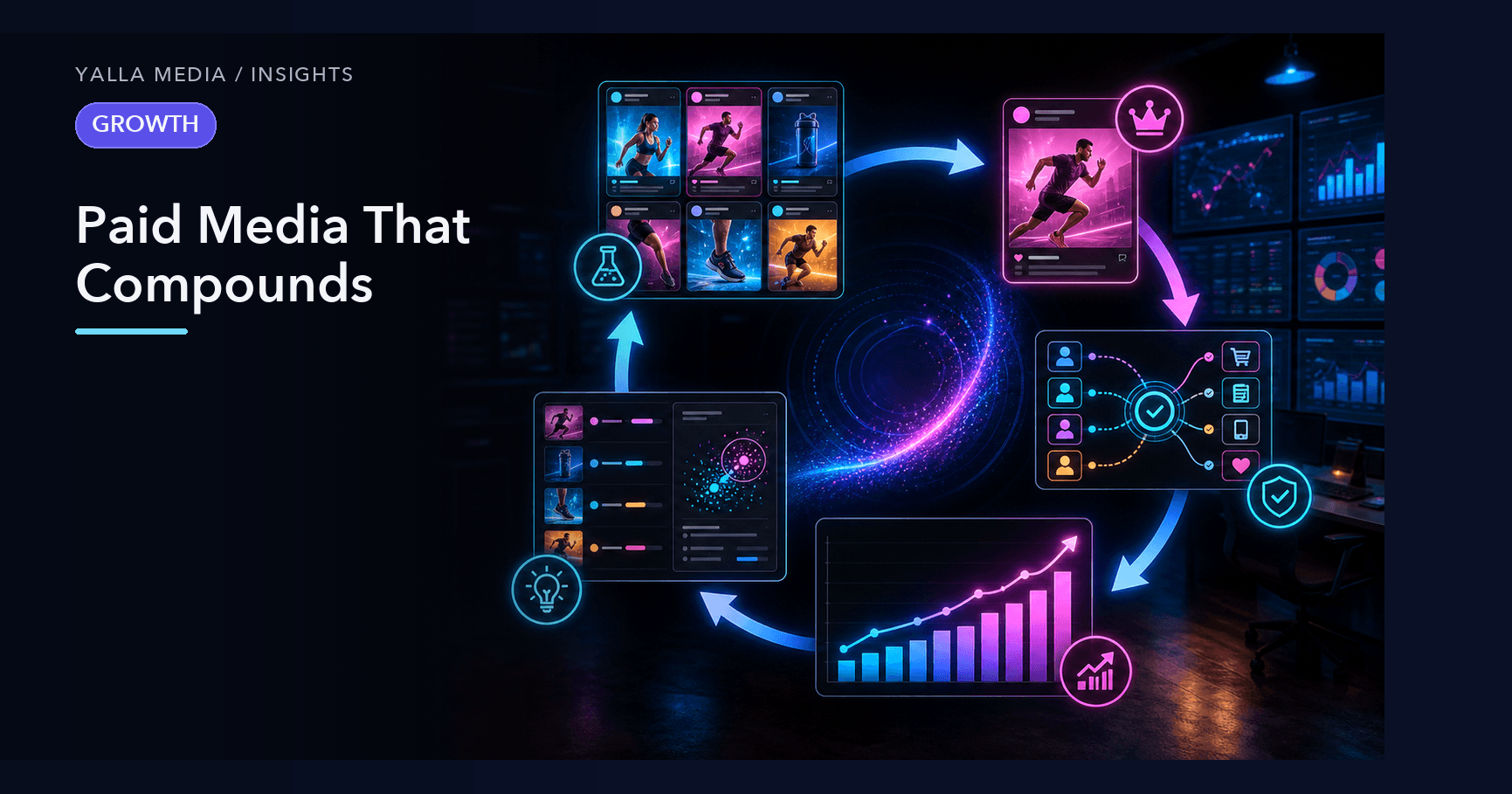
The creative system and the attribution system are not separate projects — they are two halves of one loop. Clean attribution tells you which creative actually drove results, which feeds the learning library with truth instead of platform flattery. The learning library tells you what to produce next, which the attribution system then measures honestly. Each cycle the loop tightens: better signal sharpens the learnings, better learnings sharpen the creative, and the cost of finding the next winner drops.
Creative without clean attribution learns the wrong lessons. Attribution without a creative system measures beautifully and changes nothing. The compounding is in the loop, not in either half alone.
What compounding looks like in practice
An account running this way feels different month over month. The hit rate on new creative climbs, because each batch is informed by an accumulating understanding of the audience. The reporting reconciles, because there is one source of truth instead of a pile of competing claims. Budget moves toward what genuinely works and away from what merely looked good. And the team spends less energy relitigating the same questions, because the answers are written down and trusted.
None of this requires a bigger budget than your competitors. It requires a better system. Build creative that learns and remembers, measure with signal you can trust, and connect the two into a single loop. Do that, and paid media stops resetting to zero every month and starts doing what good assets do — getting more valuable the longer you run it.