
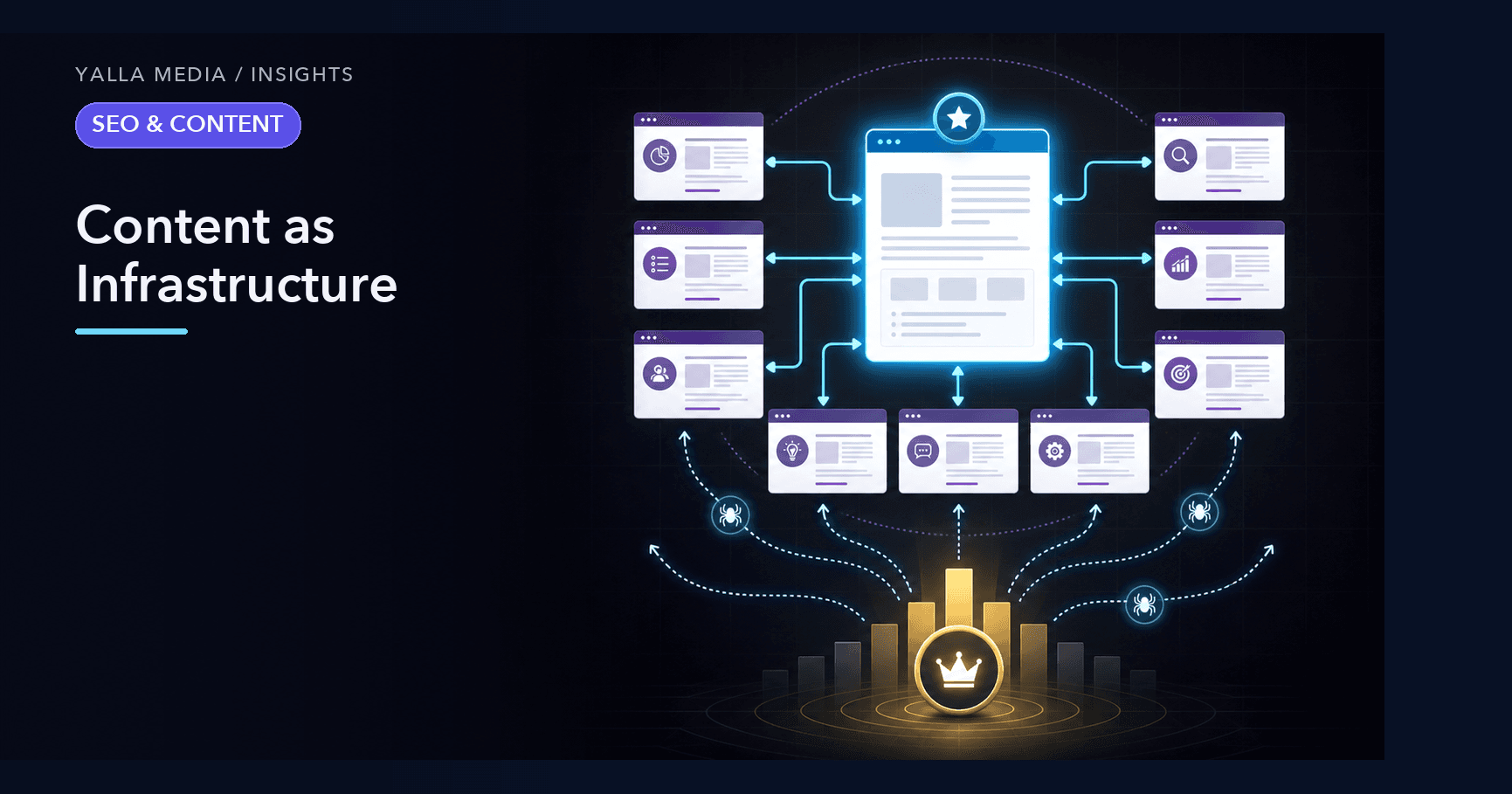
Most content programs operate like a printing press: produce an article, publish it, move on. The page either ranks or it does not, and either way the team is already drafting the next one. This is busy work disguised as strategy. The programs that actually compound treat content as infrastructure — a connected system where every page has a job, a place, and a relationship to the pages around it.
Infrastructure is the right metaphor because infrastructure has structure that outlives any single component. A road network is more valuable than the sum of its roads. The same is true of a content library: when topics are mapped deliberately and wired together, each new page does not just stand on its own — it reinforces everything published before it, and inherits strength from it.
Why isolated articles plateau
A single strong article can rank. A dozen unrelated strong articles will each fight their own battle, alone, against competitors who have built depth. Search engines reward demonstrated expertise across a subject, not lucky hits on individual queries. When your coverage is shallow and scattered, you signal a generalist. When it is deep and connected, you signal an authority — and authority is what earns the competitive rankings worth having.
The plateau shows up predictably. Early wins come easily on low-competition phrases. Then growth stalls, because the harder, higher-intent queries demand context the site has not built. You cannot rank for the hard terms until you own the easy ones around them and connect the two.
Start with a topical authority map
Before writing anything, map the territory. A topical authority map is a structured inventory of every meaningful subject and sub-subject in your space, organized into clusters. Think of it as the blueprint that turns scattered ideas into a coherent estate.
Pillars and clusters
Each major theme becomes a pillar — a broad, foundational page that defines the subject and routes readers deeper. Around it sit cluster pages, each answering a specific, narrower question in detail. The pillar gives breadth; the clusters give depth. Together they tell search engines you have covered the subject thoroughly rather than dabbling.
- Pillar: the comprehensive overview of a core theme, written to be genuinely useful on its own.
- Clusters: focused pages that each own one sub-question and link back up to the pillar.
- Supporting pages: definitions, comparisons, and how-to pieces that catch long-tail intent and feed the cluster.
Cover the question, not just the keyword
A keyword is a label; a question is a need. Map the real questions a reader works through on their journey — what they ask first, what they ask once they understand the basics, what they ask right before they decide. Coverage that mirrors a genuine learning path is what reads as authority, both to people and to the systems ranking the page.
Internal linking is the wiring
A map is just a plan until the pages are connected. Internal links are the wiring that turns a pile of articles into infrastructure. They do three jobs at once: they guide readers to the next useful thing, they distribute ranking strength across the library, and they tell search engines how your topics relate.
The single most underused growth lever in content is the link you already have the right to place — from a page you already own, to a page you already published.
Treat internal linking as a discipline, not an afterthought. A few principles carry most of the value:
- Link with descriptive anchors. The clickable text should describe the destination plainly, so both readers and machines understand the relationship.
- Point strength where you want it. Your most important pages should receive the most internal links. Audit which pages are link-rich and which are stranded.
- Link in both directions within a cluster. Pillars should reference their clusters and clusters should reference their pillar and each other where relevant.
- Update old pages when you publish new ones. Every new article is a reason to revisit related pages and add a link. This is how the library tightens over time.
Treat the library as a living system
Infrastructure needs maintenance. The teams that compound do not just publish — they prune, refresh, and reconnect. Pages that have decayed get updated rather than abandoned. Thin pages get merged or expanded. New questions that emerge in your space get mapped into the existing structure rather than published as orphans.
This is also where a lean team wins. You do not need to out-produce a larger competitor; you need to out-structure them. A smaller, deliberately connected library will routinely beat a larger, disconnected one, because every page is pulling its weight and lending weight to its neighbors.
The payoff is leverage
The reason to treat content as infrastructure is leverage. Isolated articles give you linear returns — one page, one chance. A connected library gives you compounding returns, because authority earned on one topic transfers to the next, and every link you place keeps working long after it is set. Build the map, wire the pages, and maintain the system. The result is a content estate that gets stronger the more you publish, instead of merely larger.