
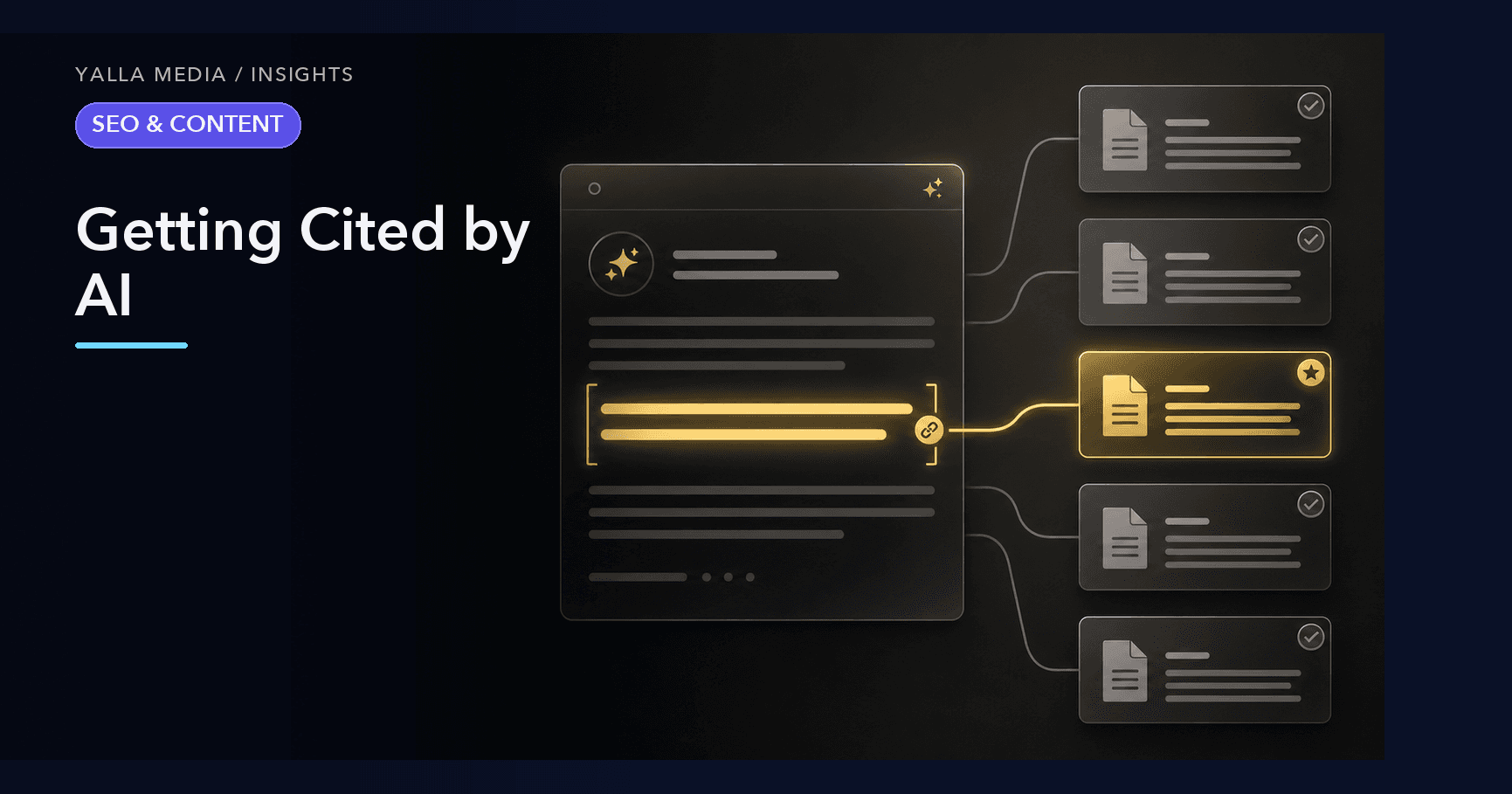
For two decades the goal was a ranking — be the blue link people clicked. That game is not over, but a second game has appeared alongside it. Increasingly, people ask a question and receive a synthesized answer that draws from a handful of sources and names a few of them. The objective shifts from ranking a page to being the source an answer engine trusts enough to quote. That discipline is answer-engine optimization — and it rewards a different kind of content craft.
The encouraging part: the fundamentals that make you citable also make you genuinely better for human readers. There is no trick here that works against quality. Clear, well-structured, trustworthy content is what both audiences want.
Understand what an answer engine is doing
An answer engine reads, synthesizes, and attributes. To be useful to it, your content has to be easy to read precisely, easy to extract cleanly, and credible enough to cite. Three jobs, and each one is something you can deliberately design for.
Extractability beats cleverness
An assistant pulling an answer needs a self-contained, unambiguous statement it can lift without distorting your meaning. Buried, hedged, or scattered answers are hard to extract safely, so they get skipped in favor of sources that state things plainly. The content most likely to be quoted reads like it was written to be quoted: direct claims, defined terms, clear structure.
Structure for extraction
Structure is the single biggest lever. Content that is well-organized into clear sections, each answering one thing, is dramatically easier to parse than a wall of prose where the answer is woven through three paragraphs.
- One question per section. Use descriptive headings that match how people actually ask. A reader — or an assistant — should know what a section answers from its heading alone.
- Lead with the answer. State the direct response first, then elaborate. Do not make the reader, or the engine, dig for the point.
- Use lists for enumerable answers. When the answer is a set of steps, options, or criteria, a list is far more extractable than a paragraph.
- Keep claims self-contained. A sentence that only makes sense with three preceding paragraphs is hard to quote. Make key statements stand on their own.
Write so that any single sentence, lifted on its own, is still true and still makes sense. That is the test for content an answer engine can quote with confidence.
Use schema to remove ambiguity
Structured data is how you tell machines, explicitly, what your content is — rather than making them infer it. Marking up a page with the appropriate schema turns implicit structure into declared structure, and declared structure is easier to trust and reuse.
- Mark up the content type. Whether a page is an article, a how-to, a question-and-answer set, or a product, say so in structured form.
- Mark up question-and-answer content so the pairing between a question and its answer is unambiguous.
- Declare authorship and freshness. Who wrote it and when it was updated are signals of credibility and currency.
Schema does not replace good content — it describes it. But describing your content precisely removes guesswork, and removing guesswork makes you a safer source to cite.
Earn the trust that gets you quoted
An answer engine, like a careful person, prefers to cite sources it can rely on. Trustworthiness is therefore an optimization target, not a soft virtue.
Signals that build credibility
- Accuracy. Be right, and be checkable. Sources that get things wrong get dropped.
- Specificity. Concrete, precise content reads as more authoritative than vague generality. Say the actual thing.
- Demonstrated expertise. Depth across a subject — the kind of topical coverage that signals you know the field — makes you a more natural source to draw on.
- Honesty about limits. Content that acknowledges nuance and does not overclaim reads as more trustworthy, not less.
The two games reinforce each other
None of this asks you to choose between ranking pages and earning citations. Clean structure, descriptive headings, self-contained claims, accurate schema, and genuine expertise serve both. A page built to be cited by an answer engine is also a better page for a person who lands on it.
The shift underway is real: a growing share of attention now flows through synthesized answers rather than ranked lists. The response is not panic, and not a pile of tricks. It is the same discipline that has always defined good content — clarity, structure, and trust — applied with the awareness that a machine is now part of your audience, and it is reading carefully.